经验

经验

适用于所有行业的可靠、稳定的SIP通信解决方案。

所有案例

接触点

接触点

领先的工业特殊通信提供商,拥有丰富的全球案例。我们的防爆和SIP调度系统为项目提供动力——您可靠的合作伙伴,并取得了成功。

继续浏览

交通运输

公共安全

Energy Industry

资源

资源

发现最佳实践,探索创新解决方案,并与Becke社区的合作伙伴建立联系。

联系我们
知识
2026-08-24 15:34:24
如何将防爆电话与统一通信集成
了解防爆电话如何通过直接SIP注册、FXS网关和混合网络连接到统一通信,并提供有关呼叫路由、寻呼集成、弹性和调试的实用指南。

贝克电信
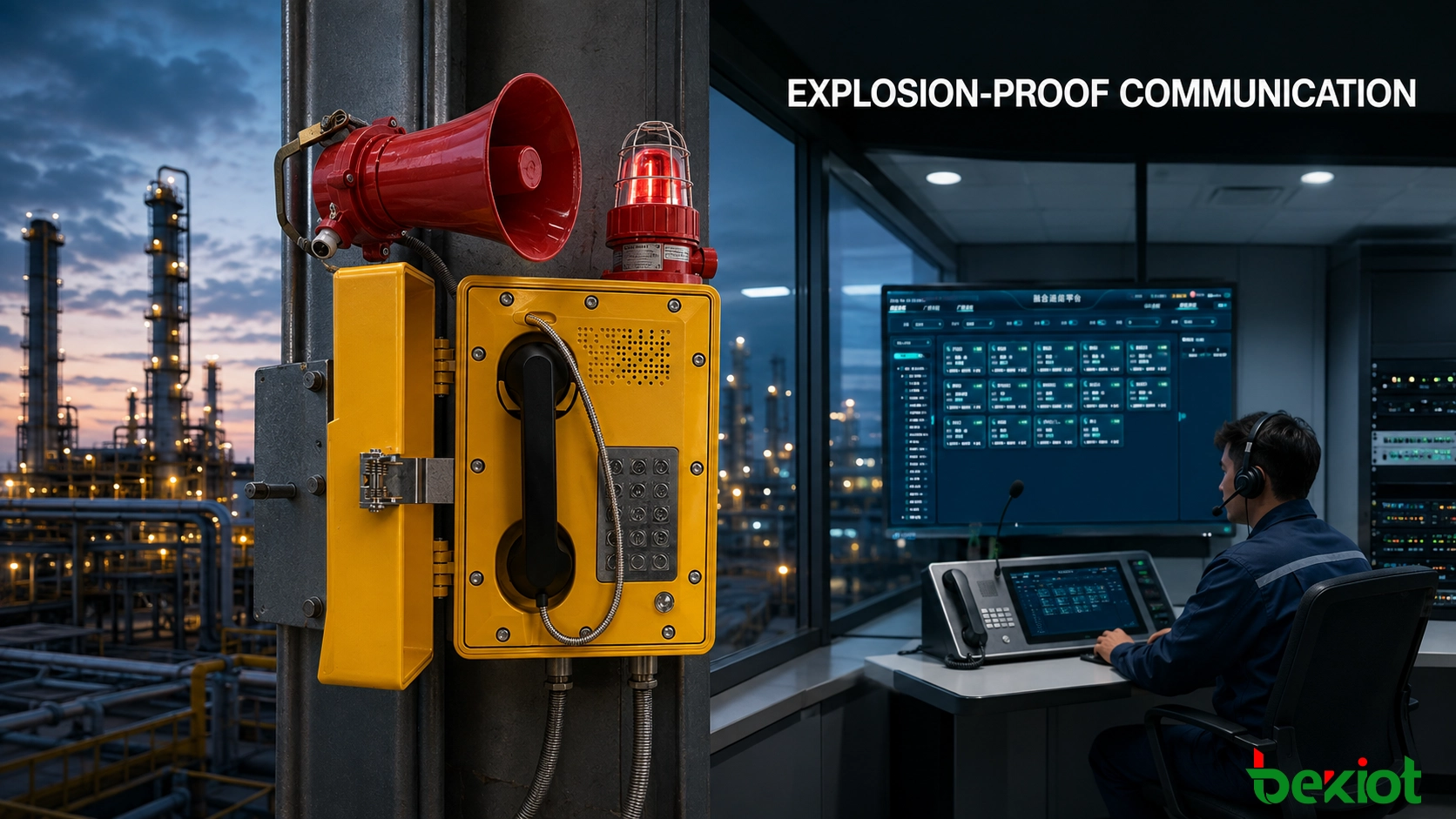
如何将防爆电话与统一通信集成

安装防爆电话只能解决现场终端的基本需求,并不代表整套通信系统已经完成。系统能否可靠运行,还取决于电话如何连接控制室、呼叫如何路由、操作人员如何识别来电位置,以及经过确认的事件如何进一步转入广播或紧急通知流程。

防爆电话可以通过 SIP 直接注册、FXS 语音网关或混合架构接入系统。混合架构可以将现有模拟线路与新的 IP 终端整合在一起。适合的接入方式取决于现场布线、网络可用性、操作流程,以及发生故障时仍需保持的通信服务。

明确划分危险区域与安全区域

系统设计应从危险区域的边界开始。现场电话可以安装在工艺装置、装卸区、罐区、泵站及其他经过现场风险评估确认的场所。IP PBX 服务器、语音网关、录音系统、调度台及核心网络交换机通常设置在控制室、设备间或其他合适的安全区域。

将中央设备设置在危险区域之外,可以简化维护工作,并减少暴露在危险环境中的有源设备数量。但是,安装在危险区域内的每一台交换机、电源设备、接线盒、媒体转换器及电缆入口,都需要单独评估其适用性。设备不会因为与防爆电话同属一套通信系统,就自动获得相同的防爆保护等级。

典型的通信路径如下:

防爆电话 → 工业网络或现场电话线路 → 交换机或语音网关 → 融合通信平台 → 调度台、值班室电话与广播系统

建筑物之间的连接需要额外考虑。长距离铜缆可能受到雷击、电磁干扰及接地电位差的影响。在条件允许的情况下,可以使用光纤作为厂区骨干网络,并将铜缆以太网或电话线路限制在接近现场终端的最后一段。电缆路由、接地、浪涌保护及机械防护应符合现场电气设计与危险区域施工要求。

选择合适的接入架构

SIP 直接注册

在已经具备工业以太网的新建项目中,SIP 防爆电话可以连接至工业交换机,并直接注册到 IP PBX、SIP 服务器或融合通信平台。平台为终端分配分机号码,并应用所需的通话权限、呼叫目标、录音策略及故障切换规则。

SIP 防爆电话 → 工业交换机 → 融合通信平台 → 调度台或值班室电话

直接注册可以减少协议转换环节,并集中管理终端状态、网络地址及通话记录。通常可以通过网络与账号配置增加新的电话,不必从每个现场位置单独铺设模拟双绞线至设备间。

EX-BH621 等 SIP 终端可以在该架构中作为现场分机使用。但是,其是否适用于指定的安装区域、供电方式及网络接口,仍需根据实际项目条件与最新产品资料进行确认。

如果终端通过网络供电,设计文件应记录交换机的可用功率预算、电缆长度及备用电源配置。如果使用独立电源,则应分别记录电源与数据路径,以便在终端离线时进行故障诊断,而不必检查与问题无关的设备。

通过 FXS 网关接入模拟电话

许多现有厂区仍在使用模拟防爆电话及现场电话线路。如果电话与线路状态良好,可以将其连接至语音网关的 FXS 端口。网关会将模拟线路转换为 SIP 分机,并接入 IP PBX 或融合通信平台。

模拟防爆电话 → 现场电话线路 → FXS 语音网关 → 融合通信平台

网关转换适合需要保留现有现场设备、控制短期更换范围的改造项目。网关只能完成接口转换,无法修复现场线路中的绝缘故障、受潮、端子腐蚀或电气干扰。因此,在系统集成之前,应检查线路状态、环路长度及端接质量。

每一个 FXS 端口都应固定对应一台现场终端及其安装位置。如果变更端口或线路,必须同步更新网关端口对照表、分机记录、调度界面的位置名称及竣工图。否则,调度台显示的位置可能与实际来电位置不一致。

混合部署

大型工业场所通常会分区域、分阶段进行系统升级。现有工艺区可以继续使用模拟电话,而新建建筑或扩建生产区则使用 SIP 终端。将模拟线路通过 FXS 网关接入,并让 IP 终端直接注册,即可在同一套融合通信平台中管理两类终端。

接入方式现场连接主要设备典型应用
SIP 直接接入工业以太网工业交换机与融合通信平台新建项目或具备合适网络覆盖的区域
网关转换模拟电话线路FXS 语音网关与融合通信平台保留现有现场设备的改造项目
混合网络以太网与模拟线路工业交换机、语音网关与融合通信平台大型厂区的分阶段升级

混合设计必须明确标示接口转换的位置。系统图应区分哪些区域使用 SIP 直接接入、哪些区域保留模拟线路、网关安装在哪里,以及中央平台或广域网络中断时,哪些本地通信服务仍需保持运行。
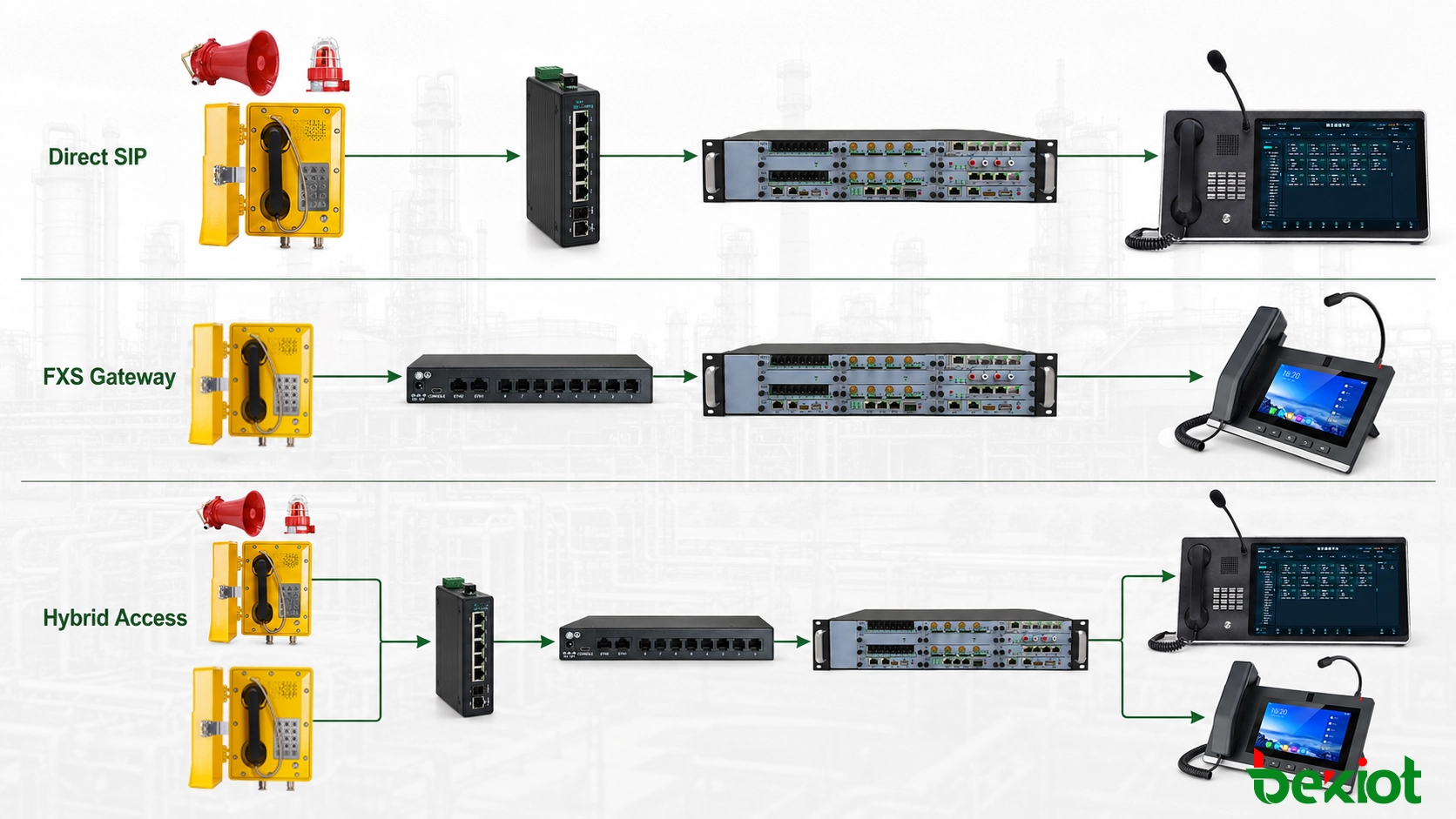
展示防爆电话 SIP 直接接入、FXS 网关接入与混合接入方式的系统架构
可以根据现有网络与现场布线条件,选择 SIP 直接接入、FXS 网关接入或混合架构。

按照实际位置规划编号与呼叫路由

电话接入后,平台应将分机号码与实际安装位置建立对应关系。只显示“8001”之类的分机号码,对操作人员的帮助有限。调度界面还应显示“东侧罐区”“2 号装卸区”或“公用工程泵房”等清楚且符合现场使用习惯的位置名称。

覆盖多栋建筑或多个厂区的系统,可以采用由厂区前缀、区域代码及终端编号组成的编号规则。罐区、装卸区、生产装置及公用工程建筑可以分配不同的号码范围。这种结构有助于操作人员快速识别来电位置,也方便维护人员追踪对应的交换机端口、网关通道及现场线路。

呼叫路由应按照值班安排设置,而不是将所有现场电话都转接到同一个目标。常见的路由策略包括:

  • 优先将现场来电转接至负责该区域的调度席位;
  • 将未接听的来电转接至值班组或备用操作人员;
  • 同时呼叫多个调度席位;
  • 为紧急呼叫点设置独立的目标或更高优先级;
  • 记录指定通话的来电号码、时间及接听席位。

系统还需要明确定义忙线、未接听及终端离线时的处理方式。顺序路由、同时振铃及备用号码会产生不同的操作结果。所选方式应符合现场职责分工,而不是直接采用通话平台的默认行为。

多厂区部署还需要定义广域网络中断时的系统行为。如果中央平台无法连接时,现场电话仍需呼叫附近的值班室,就必须在系统架构中加入本地呼叫路径,并在验收测试期间进行确认。

将现场通话与调度及广播流程整合

电话与广播系统承担不同的功能。电话用于现场人员与操作人员之间的双向通信,广播系统则将实时或预录音频传送到一个或多个区域。融合通信平台可以将两种流程连接起来,但不应将它们视为同一项服务。

操作人员确认后启动广播

现场人员致电控制室,报告事件位置与当前状况。操作人员通过来电识别及画面显示的位置确认信息后,再从调度台选择需要通知的广播区域。

操作人员确认模式适合在发布大范围通知前必须先核实的生产事件。操作人员可以按照实际受影响范围,选择单一区域、多个相邻区域或全厂广播组。

通过专用分机启动广播

平台可以为每栋建筑、生产区或全区广播组设置专用的广播分机。授权操作人员呼叫相应分机后,音频会通过广播寻呼网关、SIP 扬声器或现有公共广播系统传送。

广播目标应具备明确的权限、播报前提示音、忙线处理及会话结束规则。全厂广播组不应开放给所有普通分机使用。当某个区域已经在使用时,平台必须明确规定第二个广播请求是被拒绝、进入队列,还是按照优先级中断当前广播。

报警触发消息与视觉警示

报警控制器及第三方系统可以通过支持的接口,将事件发送至融合通信平台。平台可以选择指定目标,并启动预录消息播放或视觉、声音报警设备。

现场通话或报警事件 → 来源与权限检查 → 操作人员确认或执行平台规则 → 选择通知区域 → 实时或预录音频 → 结束并恢复正常状态
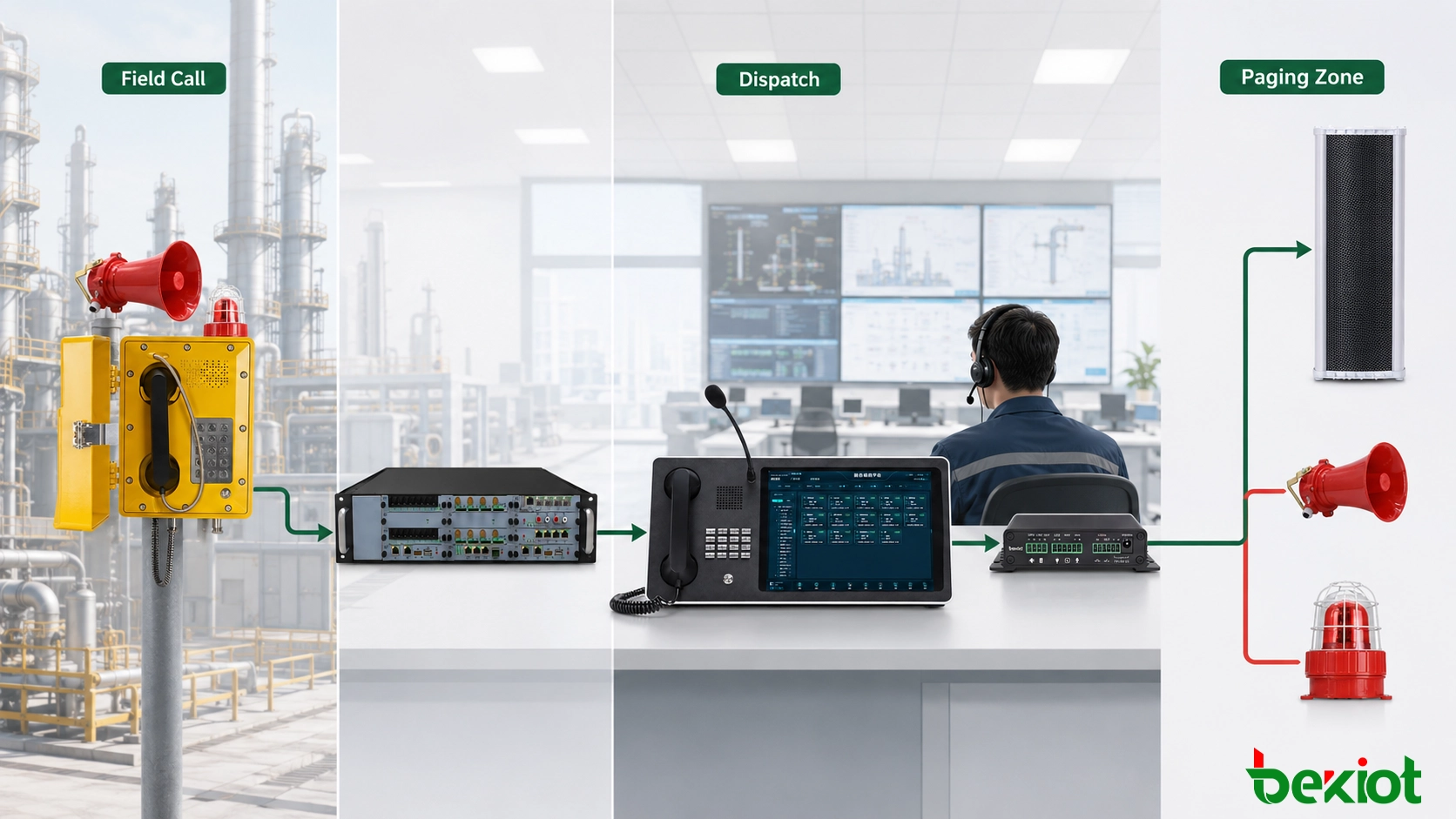
连接 IP PBX、调度台、广播寻呼网关与工业扬声器的防爆电话
经过确认的现场来电可以通过调度平台,进一步通知指定的广播区域或报警区域。

自动联动流程应明确记录触发来源、接口、消息存储位置、目标区域、优先级及复位条件。通话平台上的高优先级设置,不会自动替代公共广播功放中的其他音源。广播寻呼网关、广播控制器及功放必须在完整音频路径中支持预定的优先或静音控制。

如果广播系统需要承担火灾报警或其他生命安全功能,则必须按照适用的项目要求与法规,对整套系统进行评估。将电话与广播整合,并不会自动把一般通信系统转变为符合规范的紧急语音报警系统。

同时规划语音质量与服务连续性

SIP 终端显示为已注册,并不能证明语音路径运行正常。SIP 通常负责终端注册、呼叫建立及通话结束,而 RTP 则负责承载语音媒体。因此,电话可能显示在线,但通话仍可能出现无声、单向语音或间歇性中断。

通信阶段主要功能常见故障
SIP 注册将终端与平台建立关联验证失败、超时或反复丢失注册
呼叫路由选择目标并应用通话权限呼叫被拒绝、错误转接或路由循环
媒体协商协商编解码器及媒体地址无声、单向语音或编解码器不兼容
网络传输传输信令与语音数据包延迟、抖动、丢包或语音间歇中断

在需要的情况下,可以将语音设备部署在独立 VLAN 中,并在实际通信路径上应用访问控制与服务质量策略。测试不应只在没有流量的网络中进行,而应模拟正常生产环境的网络负载。经过共享上行链路或广域网络的通话,需要重点检查端到端延迟、抖动、丢包及路由稳定性。

电话、网关、IP PBX 服务器、调度台及录音系统应采用一致的编解码器规划。不必要的转码会消耗平台资源,并可能增加通话延迟。当模拟终端与 SIP 终端共用相同的呼叫路由时,应同时检查网关及中央平台上的媒体设置。

可用性规划应覆盖完整的通信链路:

  • 现场电话与工业交换机是否需要备用电源;
  • 单台交换机故障是否会中断整个生产区域的通信;
  • 网关与终端故障如何通知操作人员;
  • 融合通信平台是否需要冗余或备用注册;
  • 调度台故障时,值班室电话是否仍能接收必要来电;
  • 广域网络中断期间,本地通话是否仍可使用;
  • 广播系统无法使用时,应采用哪一种替代通知方式。

双服务器运行、备用注册、冗余网络路径及离线消息播放,并不是所有设备都会自动支持的功能。在纳入最终设计之前,必须根据选用的硬件、软件版本及授权配置,逐项确认各种保护机制。
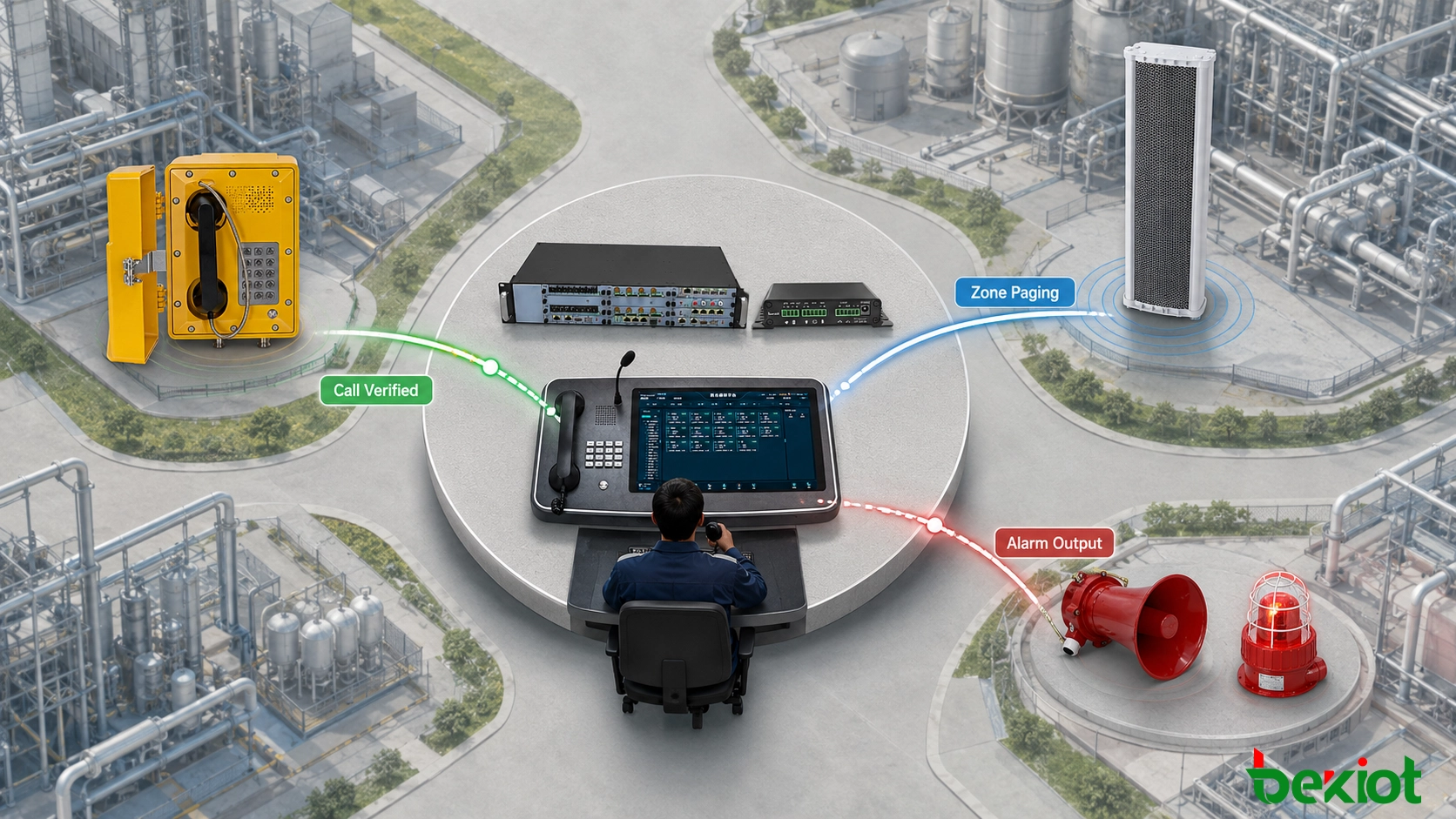
具有主用与备用通信路径的冗余防爆电话系统
主用与备用通信路径应在明确定义的网络、电源及平台故障条件下进行测试。

按照完整操作流程进行测试与验收

一次成功的测试通话,不能证明系统已经具备正式运行条件。验收测试应覆盖从现场电话、操作人员、广播目标到服务恢复的完整流程。

  1. 确认终端记录。 检查每一台电话的分机号码、设备名称、安装位置,以及对应的交换机端口或网关通道。
  2. 测试双向通话。 从现场呼叫调度台、由调度台回拨现场,并确认与值班室电话之间的通信。
  3. 确认位置显示。 调度界面显示的位置应与现场标签及竣工图一致。
  4. 评估作业噪声下的语音清晰度。 在附近设备运行时,检查语音清晰度、接听音量、延迟、单向语音及间歇中断。
  5. 确认所有广播目标。 测试单一区域、广播组及全区广播,并确认音频不会传送到未选择的区域。
  6. 测试忙线与优先级。 确认广播区域正在使用或收到更高优先级请求时,系统是否按照预期处理。
  7. 中断网络与电源路径。 记录哪些服务停止、哪些服务仍可使用,以及终端是否可以自动恢复。
  8. 检查系统记录。 对比通话记录、录音与报警时间戳,确认各系统使用一致的时间源。

验收完成后,项目文件应包括终端账号、编号规则、网关端口对照表、网络地址、广播组、呼叫路由及软件版本。这些资料可以作为后续系统扩展、故障排查及配置变更的受控基准。

一套可以投入使用的系统,应能够将现场来电连同准确的位置信息传送给负责的操作人员,按照批准流程启动广播或报警联动,并在指定的网络或设备故障后,以可预期的方式恢复服务。

Becke Telecom 为危险区域及严苛工业环境提供通信设备与系统集成支持,产品包括 EX-BH621 等防爆电话、工业电话、语音网关、IP PBX 系统、广播寻呼网关及调度终端。这些设备可以根据现场网络、现有布线与操作流程进行组合,不必为所有项目采用相同的接入架构。

标签:


Becke Telcom专注于铁路、隧道、石油和天然气以及海事部门的工业防爆通信,提供具有集成PA、对讲和呼叫功能的PAGA、SOS和IP电话。


版权©2012-202贝克电信版权所有

留下您的信息

如果您对我们有任何建议或问题,请随时与我们联系!

We use cookie to improve your online experience. By continuing to browse this website, you agree to our use of cookie.

Cookies

Please read our Terms and Conditions and this Policy before accessing or using our Services. If you cannot agree with this Policy or the Terms and Conditions, please do not access or use our Services. If you are located in a jurisdiction outside the European Economic Area, by using our Services, you accept the Terms and Conditions and accept our privacy practices described in this Policy.
We may modify this Policy at any time, without prior notice, and changes may apply to any Personal Information we already hold about you, as well as any new Personal Information collected after the Policy is modified. If we make changes, we will notify you by revising the date at the top of this Policy. We will provide you with advanced notice if we make any material changes to how we collect, use or disclose your Personal Information that impact your rights under this Policy. If you are located in a jurisdiction other than the European Economic Area, the United Kingdom or Switzerland (collectively “European Countries”), your continued access or use of our Services after receiving the notice of changes, constitutes your acknowledgement that you accept the updated Policy. In addition, we may provide you with real time disclosures or additional information about the Personal Information handling practices of specific parts of our Services. Such notices may supplement this Policy or provide you with additional choices about how we process your Personal Information.


Cookies

Cookies are small text files stored on your device when you access most Websites on the internet or open certain emails. Among other things, Cookies allow a Website to recognize your device and remember if you've been to the Website before. Examples of information collected by Cookies include your browser type and the address of the Website from which you arrived at our Website as well as IP address and clickstream behavior (that is the pages you view and the links you click).We use the term cookie to refer to Cookies and technologies that perform a similar function to Cookies (e.g., tags, pixels, web beacons, etc.). Cookies can be read by the originating Website on each subsequent visit and by any other Website that recognizes the cookie. The Website uses Cookies in order to make the Website easier to use, to support a better user experience, including the provision of information and functionality to you, as well as to provide us with information about how the Website is used so that we can make sure it is as up to date, relevant, and error free as we can. Cookies on the Website We use Cookies to personalize your experience when you visit the Site, uniquely identify your computer for security purposes, and enable us and our third-party service providers to serve ads on our behalf across the internet.

We classify Cookies in the following categories:
 ●  Strictly Necessary Cookies
 ●  Performance Cookies
 ●  Functional Cookies
 ●  Targeting Cookies


Cookie List
A cookie is a small piece of data (text file) that a website – when visited by a user – asks your browser to store on your device in order to remember information about you, such as your language preference or login information. Those cookies are set by us and called first-party cookies. We also use third-party cookies – which are cookies from a domain different than the domain of the website you are visiting – for our advertising and marketing efforts. More specifically, we use cookies and other tracking technologies for the following purposes:

Strictly Necessary Cookies
These cookies are necessary for the website to function and cannot be switched off in our systems. They are usually only set in response to actions made by you which amount to a request for services, such as setting your privacy preferences, logging in or filling in forms. You can set your browser to block or alert you about these cookies, but some parts of the site will not then work. These cookies do not store any personally identifiable information.

Functional Cookies
These cookies enable the website to provide enhanced functionality and personalisation. They may be set by us or by third party providers whose services we have added to our pages. If you do not allow these cookies then some or all of these services may not function properly.

Performance Cookies
These cookies allow us to count visits and traffic sources so we can measure and improve the performance of our site. They help us to know which pages are the most and least popular and see how visitors move around the site. All information these cookies collect is aggregated and therefore anonymous. If you do not allow these cookies we will not know when you have visited our site, and will not be able to monitor its performance.

Targeting Cookies
These cookies may be set through our site by our advertising partners. They may be used by those companies to build a profile of your interests and show you relevant adverts on other sites. They do not store directly personal information, but are based on uniquely identifying your browser and internet device. If you do not allow these cookies, you will experience less targeted advertising.

How To Turn Off Cookies
You can choose to restrict or block Cookies through your browser settings at any time. Please note that certain Cookies may be set as soon as you visit the Website, but you can remove them using your browser settings. However, please be aware that restricting or blocking Cookies set on the Website may impact the functionality or performance of the Website or prevent you from using certain services provided through the Website. It will also affect our ability to update the Website to cater for user preferences and improve performance. Cookies within Mobile Applications

We only use Strictly Necessary Cookies on our mobile applications. These Cookies are critical to the functionality of our applications, so if you block or delete these Cookies you may not be able to use the application. These Cookies are not shared with any other application on your mobile device. We never use the Cookies from the mobile application to store personal information about you.

If you have questions or concerns regarding any information in this Privacy Policy, please contact us by email at . You can also contact us via our customer service at our Site.